







Chat with us
Online
00:00
Hi! How can I help you?
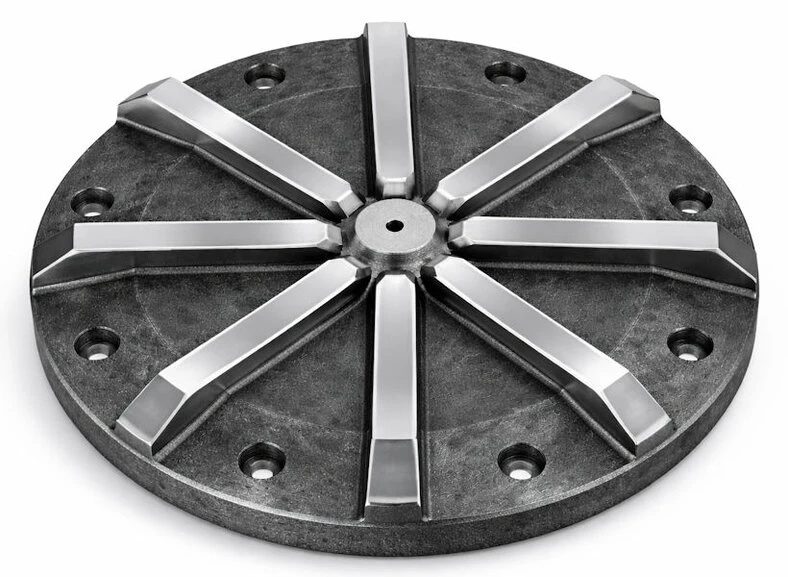
The center plate is responsible for receiving pulp that enters axially through the rotor center and redirecting it radially in a uniform manner to the peripheral refining zone. The spiral-shaped wings optimize flow, prevent accumulations in the center, and maximize the energy efficiency of the refining process.
This equipment represents a critical component in disc refiners used in pulp and paper manufacturing. The continuous evolution of refining technologies, focusing on energy efficiency and pulp quality, positions the center plate as a critical element for the competitiveness of the pulp and paper industry. Proper selection of material, wing design, and dimensional specifications directly impacts pulp quality, energy consumption, and operational costs.
Curved Monolithic
Recommended Applications
- Thermomechanical pulp (TMP/CTMP) high consistency (25-35%)
- Long fiber refining (softwood)
- High flow rate applications (>100 m³/h)
- Continuous 24/7 operation
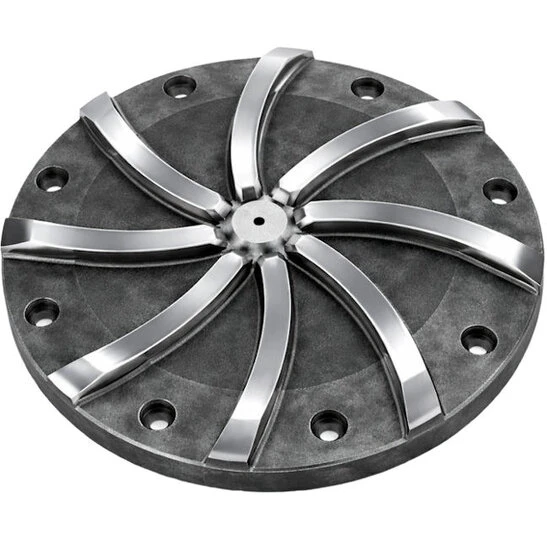
Specifications
- Medium-sized refiners; diameter 450-610mm (18"-24")
- 8 wings 45° between (polished finish)
- 8 × M16 mounting holes
- 316L stainless steel or special alloy
Flow Characteristics
- Optimized centrifugal spiral flow pattern
- High feeding efficiency (turbine design)
- Turbulence reduction: excellent due to smooth curves
- Good Self-cleaning capacity
Segmented Center Plates
Recommended Applications
- Recycled pulp with contaminants
- High abrasion applications
- Refiners > 26" where weight is critical
- Operations with frequent scheduled maintenance
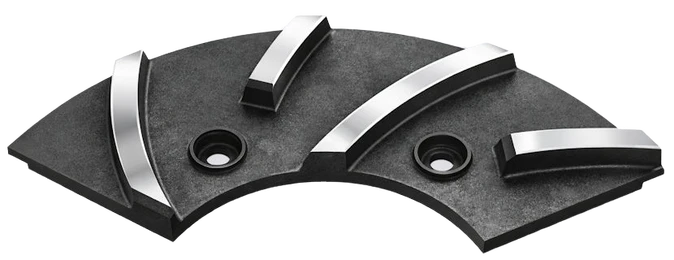

Specifications
- Arc length: ~120-150mm
- Width: ~80-100mm
- Thickness: ~25-35mm
- Mounting holes: 2 × M12
Operational Characteristics
- Modularity: Individual segment replacement
- Wear resistance: Very high (carbide inserts)
- Service life: 6,000-10,000 hours
- Maintenance ease: Excellent
Straight Radial Center Plate
Recommended Applications
- Low Intensity Refining (Kraft)
- Suitable for chemical fibers and low consistency
- Low initial cost
- Maintenance Flexibility
- Pilot plants and laboratories
- Low capacity refiners (<50 t/day)
- Testing and development applications
- Intermittent operation
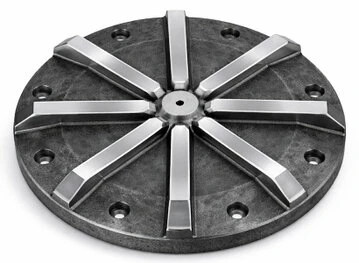
Specifications
- Steel Grade: 316L or equivalent
- Corrosion resistance: Excellent in pulp environment
- Finish: Ra 0.8-1.6 μm (polished)
- Weldability: Good for repairs
Operational Characteristics
- Consistency: 8-15%Temperature: 60-90°C
- Pressure: 2-5 bar
- Rotation: 1,500-2,400 rpm
- Recommended gap: 1.0-2.0mm
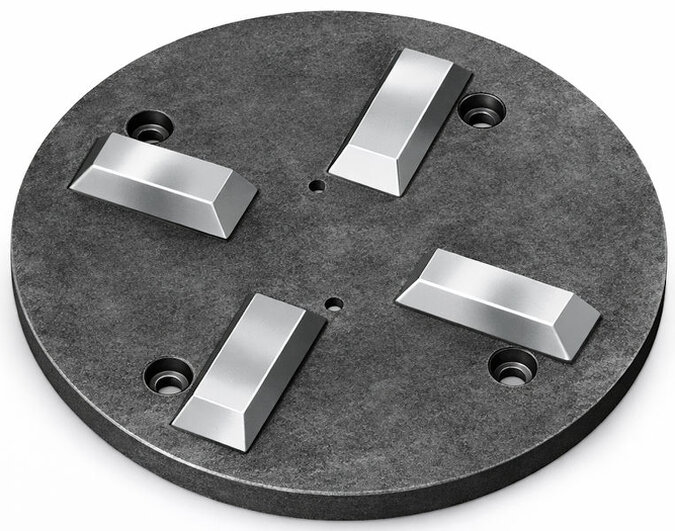
Compact Center Plates
Recommended Applications
- Lowest Initial Cost
- Maintenance FlexibilityLow Intensity Refining (Kraft)
- Suitable for chemical fibers and low consistency
- Small-Scale Plants
- Simplicity and cost-effectiveness
Specifications
- Specific Energy (kWh/t): 100-150
- Freeness Reduction (mL CSF): 100-250
- Availability (%): >93
- Service Life (hours): 3,000-5,000
Operational Characteristics
- Consistency: 3-12%
- Temperature: 40-70°C
- Pressure: 1-3 bar
- Rotation: 1,800-3,000 rpm
- Recommended gap: 1.5-3.0mm
Technical and Dimensional Specifications
Weight and Handling Specifications
Weight Criteria by Category:
- 12"-26" Refiners: Relatively lightweight segments, allowing manual handling
- >26" Refiners: Segment weight exceeds 20 pounds (9kg), requiring lifting equipment
- Durabond Light Solutions: Developed by ANDRITZ to reduce segment weight below 20 pounds, facilitating installation and maintenance
Manufacturing Tolerances
Adjustable Gap Control:
- Precision of 0.1-2.0mm for high-precision refining
- Single-post plate parallelism adjustment system
- Automated vibration monitoring for stable operation
Diameter Variations
Available Standard Sizes:
- 12" to 26" (305mm to 660mm): Small to medium-sized refiners
- Φ450mm, Φ480mm, Φ550mm, Φ600mm are common specifications
- Used in lower capacity applications and pilot plants
- 26" to 46" (660mm to 1,168mm): Large-scale refiners
- High-capacity industrial applications
- Require specialized handling systems due to weight
- Above 46" (>1,168mm): Maximum industrial capacity refiners
- Used in large pulp and paper mills
- Require special lifting equipment for installation
Manufacturing Materials and Properties
Primary Materials
Available Alloy Options:
- White Cast Iron: Traditional base material
- High Chromium Cast Iron: Superior wear resistance
- Nickel-Chromium Alloy: Balanced resistance and toughness properties
- Stainless Steel: Applications with corrosion requirements
- Tungsten Carbide: Maximum wear resistance for severe applications
Advanced Metallurgical Properties
ACME Taurus Alloy (Advanced Material Example):
- High carbon, high chromium (12%, 18%, 20%, 30% Cr)
- Stable Fe-Cr-C-Mo/V/B microstructure
- Complex matrix of martensite and austenite
- 16-20 hour heat treatment cycle for optimized microstructure
Wing Design and Flow Optimization
Spiral Wing Geometry
Design Characteristics:
- Arc/Spiral Format: Optimized radial flow direction
- Inclination Angle: Calculated to minimize turbulence
- Steam Openings: Allow steam flow in direction opposite to rotation
- Logarithmic Profile: Some designs use logarithmic spiral bars for uniform distribution
Industrial Applications by Pulp Type
Chemical Pulp (Kraft)
Operational Parameters:
- Consistency: 8-15%
- Application in bleached and unbleached kraft pulp refining
- Focus on strength property development
Thermomechanical Pulp (TMP/CTMP)
Specific Characteristics:
- High consistency refining (25-35%)
- Elevated temperature (120-180°C)
- Operating pressure: 4-8 bar
- Specific energy: 1,800-3,000 kWh/t
Recycled Paper
Specialized Applications:
- Secondary fiber refining
- Contaminant removal
- Bonding property improvement
- Typical consistency: 3-6%
Maintenance and Operational Life
Maintenance Intervals
Typical Schedule:
- Visual Inspection: Every 500-1,000 operating hours
- Segment Replacement: 2,000-8,000 hours depending on application
- Complete Overhaul: 12,000-20,000 hours or annually
Wear Indicators
Operational Monitoring:
- Increase in specific energy consumption
- Reduction in pulp quality (freeness, strength)
- Excessive refiner vibration
- Elevated bearing temperature
Predictive Maintenance Strategies
Emerging Technologies:
- Real-time vibration analysis
- Infrared temperature monitoring
- Energy consumption trend analysis
- Automated consistency control systems
Key Recommendations
- Material Selection: Prioritize high chromium alloys for high-intensity applications.
- Flow Design: Implement advanced feeding technologies for energy optimization.
- Predictive Maintenance: Adopt continuous monitoring systems to maximize service life.
- Strategic Supplier: Establish partnerships with manufacturers offering comprehensive technical support.
FAQs
Field data shows +10–20% longer service life versus baseline, subject to ash, silica, and settings.
Self-cleaning groove progression and reliefs sustain flow and limit fines accumulation.
Trials indicate +8–15% tph at comparable kWh/t by maintaining SEL and optimizing dilution.
Provide refiner model, diameter, segment count, bolt pattern, and rotation; we validate and provide adapters if needed.
Change-outs are planned by wear depth and KPIs; many mills extend intervals 10–20% with PEGASUS.
Get in Touch
Ready to improve refining performance or build custom metal parts?
Tell us about your challenge and attach drawings or data—we’ll respond quickly.